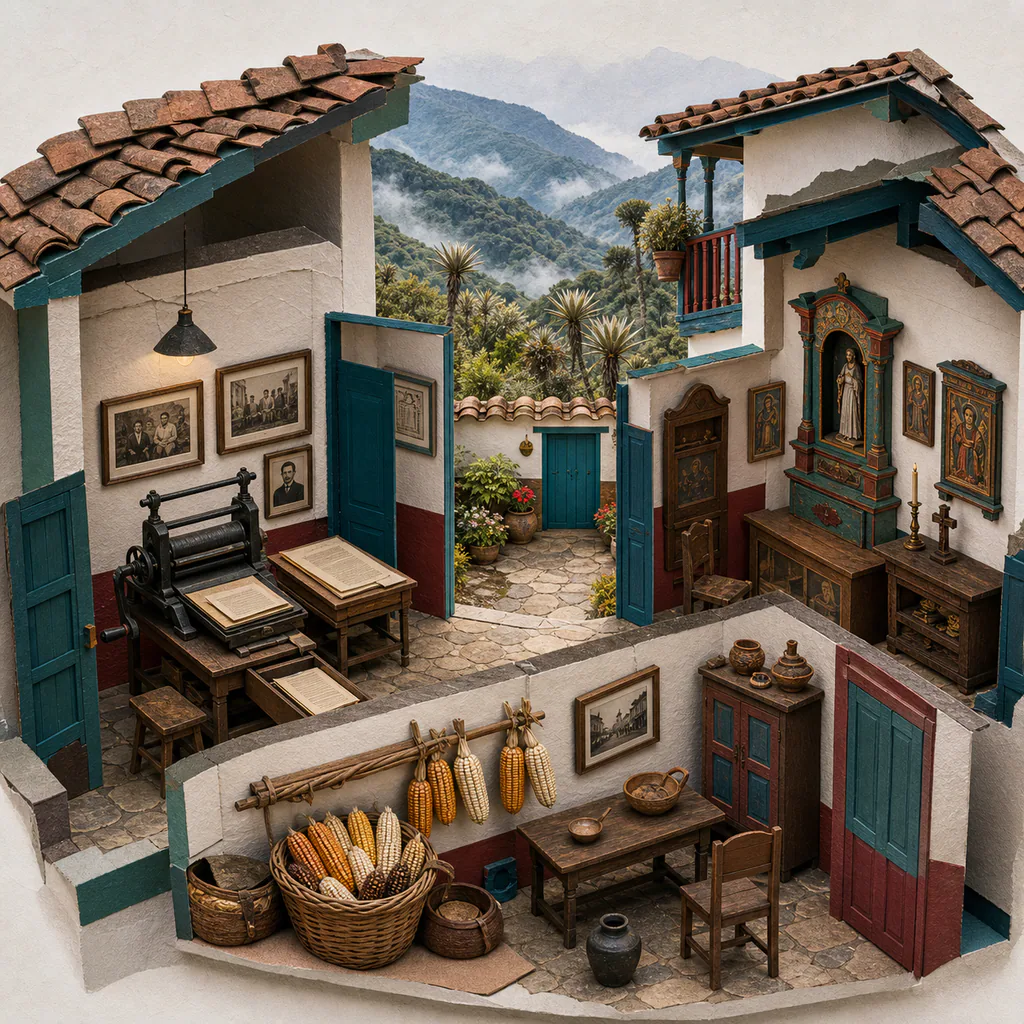
Sonsón rewards travelers who enjoy opening doors. Behind the colorful balconies and portones of this cool southeastern Antioquia town lies an unusually rich collection of small museums, family memory, religious art, maize traditions, old newspapers, and stories about regional migration. At roughly 2,475 meters above sea level, the urban center also feels different from the warmer Antioquian towns many visitors know.
This is a destination for walking slowly, asking whether a museum is open, and accepting that the best encounter may be a conversation rather than a headline attraction. In 2026, Sonsón works especially well as a two-night cultural escape, with enough time to explore its historic core while treating the surrounding high-mountain ecosystem with care.
A Highland Town Made for Slow Walks
Sonsón's central streets bring together painted wooden doors, projecting balconies, traditional facades, steep views, and the broad Plaza Ruiz y Zapata. The municipal 2026 visitor overview highlights the historic center, Cathedral of Nuestra Señora de Chiquinquirá, museums, balconies, and mountain landscapes as defining elements of the town.
Begin around the plaza, then follow the streets without trying to turn every facade into a photo set. Many attractive buildings remain homes or working institutions. Ask before photographing people, look through open public doorways only when invited, and notice practical details: rain channels, worn stone, carpentry, shop signs, and the way the mountains appear at the end of a street.
A Network of Museums, Not a Single Stop
Sonsón's strongest cultural feature is its museum network. A current municipal guide to the museums lists spaces including Casa Museo de la Cultura, Museo Casa de los Abuelos, Museo de Arte Religioso, Museo Pablo Jaramillo, the press heritage room, Granja Museo Vivo del Maíz, Museo Costumbrista La Jonda, Hotel Museo El Tesoro, and Museo Parque Cementerio San José.
That variety changes the rhythm of a visit. One room may focus on domestic objects and family life; another on local journalism, sacred art, agriculture, or funerary heritage. These are often modest institutions with limited staff rather than large urban museums. Confirm opening hours directly, group nearby visits, and leave room for a guide or caretaker to explain why an ordinary-looking object matters.
Casa de los Abuelos and Living Memory
The Museo Casa de los Abuelos is a useful anchor. In July 2026, the municipality marked the museum's 70th anniversary, describing it as a guardian of local memory, tradition, and identity. Its value is not architectural grandeur. It is the accumulation of objects, rooms, and recollections that make everyday history tangible.
Pair it with one or two contrasting spaces rather than attempting the entire network in a morning. The press collection can open a window onto local public life, while religious art reveals another side of the town's visual culture. The cemetery museum asks for a quieter approach: observe respectfully, avoid interrupting ceremonies, and remember that it remains a place of mourning.
Maize, Food, and Community Tradition
Maize is more than a menu ingredient in Sonsón. The Granja Museo Vivo del Maíz treats it as agricultural knowledge, cultural memory, and a reason for generations to gather. A 2026 municipal account describes the site hosting community storytelling and cultural activities during the local museum week.
Carry that context into lunch. Look for arepas, beans, soups, locally grown produce, and simple bakery items, then ask what is seasonal. The annual Fiesta del Maíz is an important expression of local identity, but its dates and program should be verified before booking. Outside the celebration, a market visit and an unhurried meal can communicate the relationship between town and countryside more clearly than a crowded event.
See the Páramo Without Loving It to Death
The mountains above Sonsón are ecologically significant, but not every summit is open to visitors. Cornare and the municipality restricted tourist access to Cerro Las Palomas because unmanaged visitation was damaging the fragile ecosystem. Do not follow an old blog, informal pin, or social-media route that ignores that restriction.
Instead, ask the municipal tourism office or the environmental authority which viewpoints, rural walks, or community-led routes are currently authorized. Weather, trail conditions, and conservation rules can change. A responsible visit may mean appreciating the páramo from town, choosing a lower-impact route, or leaving a sensitive area entirely alone.
Practical Tips
- Stay two nights: Museum schedules do not always align, and a flexible second day makes the visit less rushed.
- Confirm before walking over: Contact individual museums or the local tourism office for current hours, entry arrangements, and guided visits.
- Pack for cool rain: Bring a light waterproof layer, warm evening clothing, comfortable shoes, and sun protection for changing mountain conditions.
- Plan the road in daylight: The municipality places Sonsón about 113 kilometers from Medellín, but mountain travel times vary with weather and road works.
- Carry some cash: Small museums, bakeries, market stalls, and local transport may not accept cards.
- Respect conservation closures: Never enter Cerro Las Palomas or another restricted area through an unofficial guide or unmarked path.
🕵️ Insider Secrets
- Build a three-museum contrast: Combine domestic memory, press history, and maize culture instead of visiting several similar collections.
- Look up at the carpentry: Balcony brackets, doors, and window frames often carry more character than the widest facade view.
- Ask about one object: A focused question often unlocks a richer story than rushing through every room.
- Walk after light rain: Clearer air, reflective streets, and drifting cloud can transform the views, provided conditions are safe.
- Leave schedule gaps: Sonsón is at its best when a caretaker, shopkeeper, or cook has time to talk.
Sonsón is memorable because heritage here is distributed across houses, collections, food, streets, and living knowledge. Its museums reward attention, while the páramo teaches a complementary lesson: access is not the same as entitlement. Approach both with patience, and the town offers one of Antioquia's most thoughtful cultural weekends.
eSIM for Colombia
Avoid high roaming fees. Get instant 4G/LTE data with Airalo as soon as you land in Bogotá or Medellín.
- Instant Activation
- No Physical SIM Card
- Local & Regional Plans