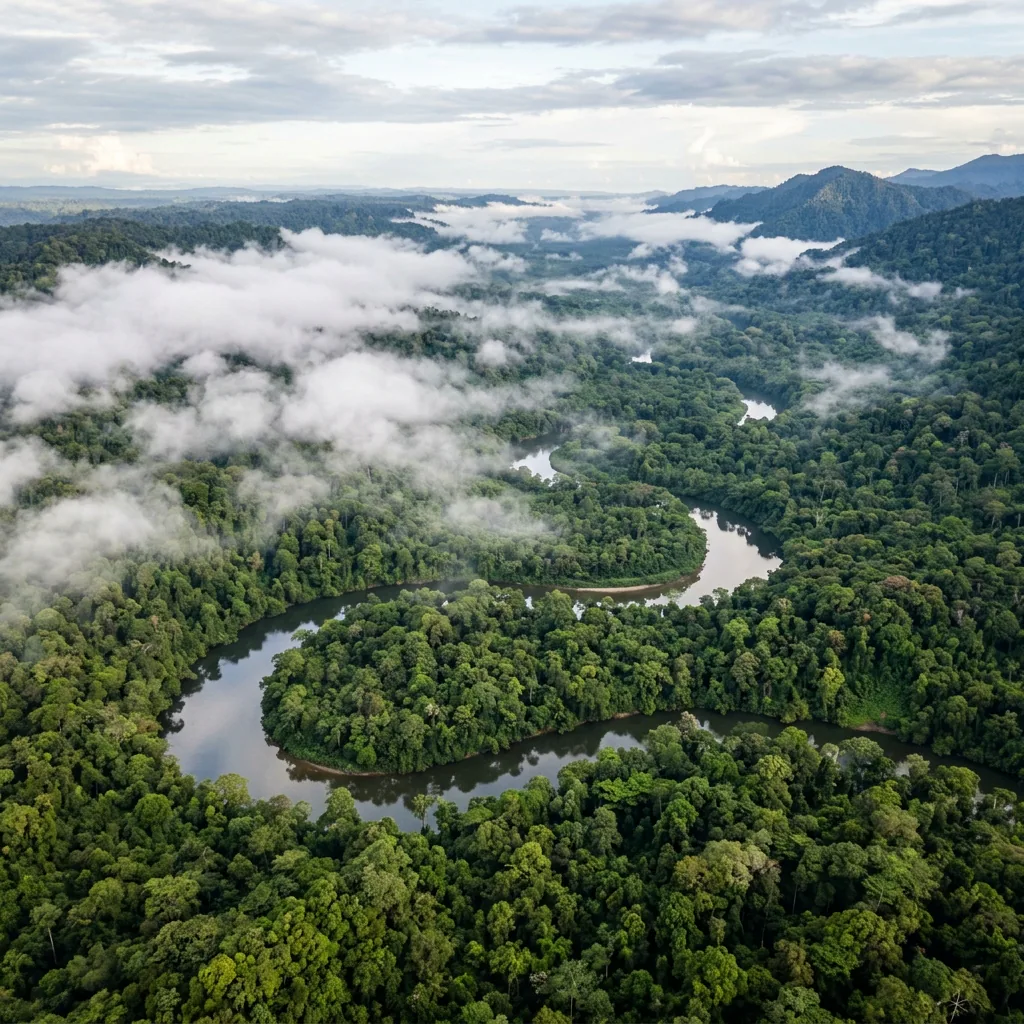
At Colombia's northwestern edge, Los Katíos protects a rare meeting point between Central and South America. Tropical forest, flooded plains, wetlands, isolated hills, and river systems create an ecological corridor of exceptional importance. UNESCO recognized the park as World Heritage in 1994 because of this biodiversity and its role in the exchange of flora and fauna across the Darién.
Parque Nacional Natural Los Katíos is currently closed and has no ecotourism activity. The official park page lists both its status as “Cerrado” and its activity as “Sin Ecoturismo.” It should not be planned as a trek, boat excursion, waterfall visit, wildlife walk, or overnight expedition. This article explains the park's significance without encouraging entry.
A Biological Bridge Between Continents
Los Katíos spans parts of Chocó and Antioquia in the Darién region. Its ecosystems include periodically flooded alluvial plains, swamps, very humid tropical forest, and cloud forest on isolated summits. This variation across a relatively compact region supports reptiles, birds, mammals, fish, and hundreds of plant species.
The park's waters connect directly with the Atrato basin and a complex network of wetlands. These aquatic and forest systems cannot be separated: seasonal flooding moves nutrients, shapes habitats, and supports communities across the wider region. The result is a living corridor where species associated with both Central and South America overlap.
This connectivity also explains why conservation decisions extend beyond a line on a map. Forest loss, water pollution, illegal extraction, and disruption in neighboring zones can affect habitats inside the protected area. Los Katíos is best understood as part of a wider social and ecological landscape rather than an isolated island of green.
Wildlife records include harpy eagles, macaws, tapirs, anteaters, reptiles, and many wetland birds. These animals are conservation subjects, not guaranteed sightings. Responsible interpretation avoids publishing sensitive locations or treating a protected species as an attraction to be pursued.
Culture, Territory, and the Darién
The Darién is not an uninhabited blank on a map. Wounaan people live within the park territory, while Tule, Emberá, and Afro-Colombian communities live in surrounding areas. Sacred places, customary knowledge, and community governance are part of the landscape's meaning. Any account of Los Katíos that focuses only on “untamed jungle” misses this human history and can reinforce harmful ideas about the region.
The area has long connected peoples, ecosystems, and waterways, but it is also affected by difficult security, transport, humanitarian, and environmental realities. Independent attempts to penetrate the Darién are not responsible tourism. They can endanger travelers, residents, and responders while placing additional pressure on communities and habitats.
Why Closure Must Be Respected
A national park closure is not a suggestion and cannot be bypassed by hiring an informal operator. There are no public ecotourism activities to reserve inside Los Katíos. Old articles may refer to Tilupo waterfall, ranger stations, trails, river journeys, or night walks, but those descriptions must not be used as current access instructions.
Check the official Los Katíos page for status changes. If the authority eventually establishes a public program, follow only the routes, capacities, community agreements, insurance requirements, and operators it explicitly recognizes. Until then, the correct visitor action is not to enter.
Learning Without Entering the Park
You can build a richer understanding of Los Katíos through official conservation material, UNESCO documentation, regional museums, academic work, and lawful community-led experiences outside the closed area. When considering a wider Urabá or Chocó itinerary, ask providers for an exact route and verify that it does not cross the national park or another restricted territory.
Supporting locally governed accommodation, food, crafts, and interpretation in destinations that are legally open can contribute to the regional economy without turning a closed protected area into an unauthorized excursion. Consent and current access information matter as much as environmental credentials.
Practical Tips
- Do not book park entry: Los Katíos currently offers no ecotourism activity, permits, hikes, or visitor expeditions.
- Ask for coordinates: Before buying a regional tour, confirm its exact route and protected-area boundaries.
- Reject improvised access: A boat owner, guide, or social-media post cannot authorize entry into a closed national park.
- Review regional conditions: Transport, river levels, weather, and security can change rapidly across Urabá and Chocó.
- Respect communities: Obtain consent before photography and follow community rules in any legally accessible settlement.
🕵️ Insider Secrets
- Begin with the watershed: Studying the Atrato and its wetlands first makes the park's ecological importance much easier to understand.
- Check publication dates: Many enticing descriptions online predate current closure information.
- Value restraint: Choosing not to enter can be the most meaningful form of support for a vulnerable protected area.
- Follow the authority: Bookmark the official park page and treat it, not a booking listing, as the source of truth.
Los Katíos remains extraordinary without being available for visitation. Its rivers, forests, species, and cultures deserve careful attention, but in 2026 that attention must begin with a simple boundary: learn from the park, support responsible conservation, and do not enter while it remains closed.
eSIM for Colombia
Avoid high roaming fees. Get instant 4G/LTE data with Airalo as soon as you land in Bogotá or Medellín.
- Instant Activation
- No Physical SIM Card
- Local & Regional Plans