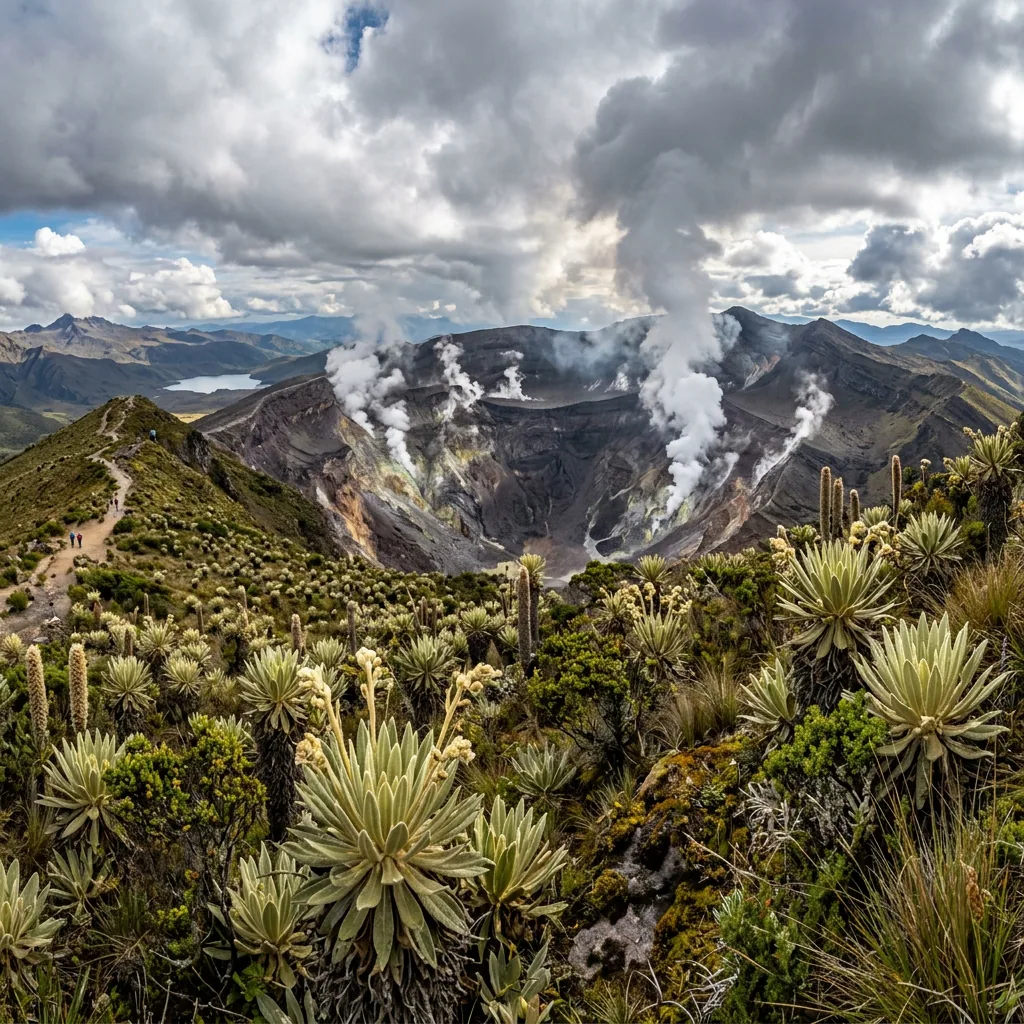
Puracé National Natural Park protects one of Colombia's most important high-mountain landscapes, but it is not currently a destination to enter. The canonical Puracé park status page records the current restriction: visitor sectors and named attractions are temporarily closed because of volcanic risk.
The controlling document is Resolution 338 of 2026, issued by Parques Nacionales on 4 August and effective from 1 August. It followed the change of the Puracé-Coconucos volcanic alert from yellow to orange. The measure remains in force until the risk factors cease and the competent authorities evaluate whether reopening is appropriate.
What the Temporary Closure Covers
The resolution closes the San Nicolás, San Juan, San Rafael, Pilimbalá, and Paletará visitor sectors. It also closes trails toward Puracé volcano, every visitor route associated with the Coconucos volcanic chain, San Juan thermal springs, and San Nicolás waterfall. Unauthorized visitors should not attempt to reach those places by a different entrance, community road, informal trail, or commercial offer.
This detail matters because the general Puracé park information page contains text written under earlier operating conditions. A trail name, tariff table, or old description does not override the newer closure resolution. Wait for an explicit reopening decision rather than asking a driver or seller to interpret conflicting web copy.
The National Roads Are Through-Routes, Not Park Access
Resolution 338 makes one precise exception: the Popayán-La Plata and Popayán-Paletará-Isnos national roads are not closed by the park measure. These roads cross the protected area and can remain transport corridors, subject to road, weather, emergency, and public-safety controls.
The exception does not turn the roadside into an open attraction. It does not authorize parking for a walk, entering a trail, visiting thermal springs or waterfalls, approaching volcanic areas, or buying an excursion into a closed sector. Anyone using the corridor for necessary travel should check the official INVÍAS road service and local risk instructions immediately before departure, keep moving through permitted sections, and avoid treating a clear road as evidence that ecotourism has resumed.
Why Puracé Still Matters While Closed
Puracé is part of the Colombian Massif, where the Central and Western Andes converge. Its páramo, high-Andean forest, Andean forest, wetlands, lagoons, and volcanic terrain help regulate water across a vast region. The Magdalena, Cauca, Patía, and Caquetá river systems all have headwaters within this protected landscape.
The park also forms part of a UNESCO biosphere reserve and overlaps the Indigenous territories of Puracé and Paletará. Kokonuko authorities are not an optional cultural detail in access decisions: their territorial knowledge and governance are part of how risk, conservation, and any future visitor activity must be coordinated.
Wildlife includes a small population of Andean condors, spectacled bears, mountain tapirs, northern pudus, pumas, oncillas, hummingbirds, ducks, and other high-mountain birds. More than 200 orchid species have been recorded. These values remain worth understanding even when the responsible action is to stay outside.
What Not to Book During the Closure
Do not pay for a Puracé summit hike, crater approach, Coconucos volcanic-chain trek, San Juan thermal-spring visit, San Nicolás waterfall outing, or condor trip that depends on entering a closed sector. A listing that remains bookable online may simply be stale. A provider saying that a route is "local," "alternative," or "outside the main gate" is not a substitute for written authorization from the protected-area authority.
Popayán remains a useful destination for architecture, food, museums, and wider Cauca context, but it should not be sold as an operating park gateway while the closure continues. Use the Popayán cultural and culinary guide to plan activities that do not depend on park entry, or compare open stops in the Southern Andes itinerary.
Practical Tips
- Read the newest legal notice: Use Resolution 338 as the current closure source and check the 2026 Parques Nacionales environmental gazette for a later reopening decision.
- Do not rely on old itineraries: Cached tour pages, videos, blogs, tariff tables, and trail descriptions may predate the August closure.
- Separate transit from tourism: The two exempt national roads may be used as through-routes when authorities permit, but they do not open roadside park attractions.
- Check volcanic information: Review Servicio Geológico Colombiano bulletins and follow emergency instructions. Do not approach emissions, ash, unusual smells, or restricted volcanic terrain.
- Keep bookings flexible: Avoid non-refundable transport or accommodation bought specifically for park entry until an official reopening defines sectors and conditions.
- Respect Indigenous authority: Do not enter community or protected territory through an informal contact. Future access must also reflect Kokonuko and Paletará decisions.
🕵️ Insider Secrets
- The water story is the real scale: Puracé is often reduced to one volcano, but its river headwaters connect the park to communities and ecosystems far beyond the crater.
- A road view is not an invitation: Passing through a dramatic landscape can feel like access. During this closure, remaining on the authorized transport corridor is the meaningful distinction.
- Conservation content can be a complete visit: Museums, regional food, official park videos, and Popayán's cultural institutions can provide context without turning risk controls into an obstacle to overcome.
- Reopening will need detail: When conditions improve, look for the exact sectors, routes, guide rules, registration, insurance, and health restrictions that reopen. A headline alone will not answer those questions.
Puracé remains a landscape of extraordinary ecological and cultural importance. In August 2026, respecting it means treating the closure as the plan: learn from reliable sources, support open experiences elsewhere in Cauca, and wait for Parques Nacionales to publish the conditions of any future reopening.
eSIM for Colombia
Avoid high roaming fees. Get instant 4G/LTE data with Airalo as soon as you land in Bogotá or Medellín.
- Instant Activation
- No Physical SIM Card
- Local & Regional Plans