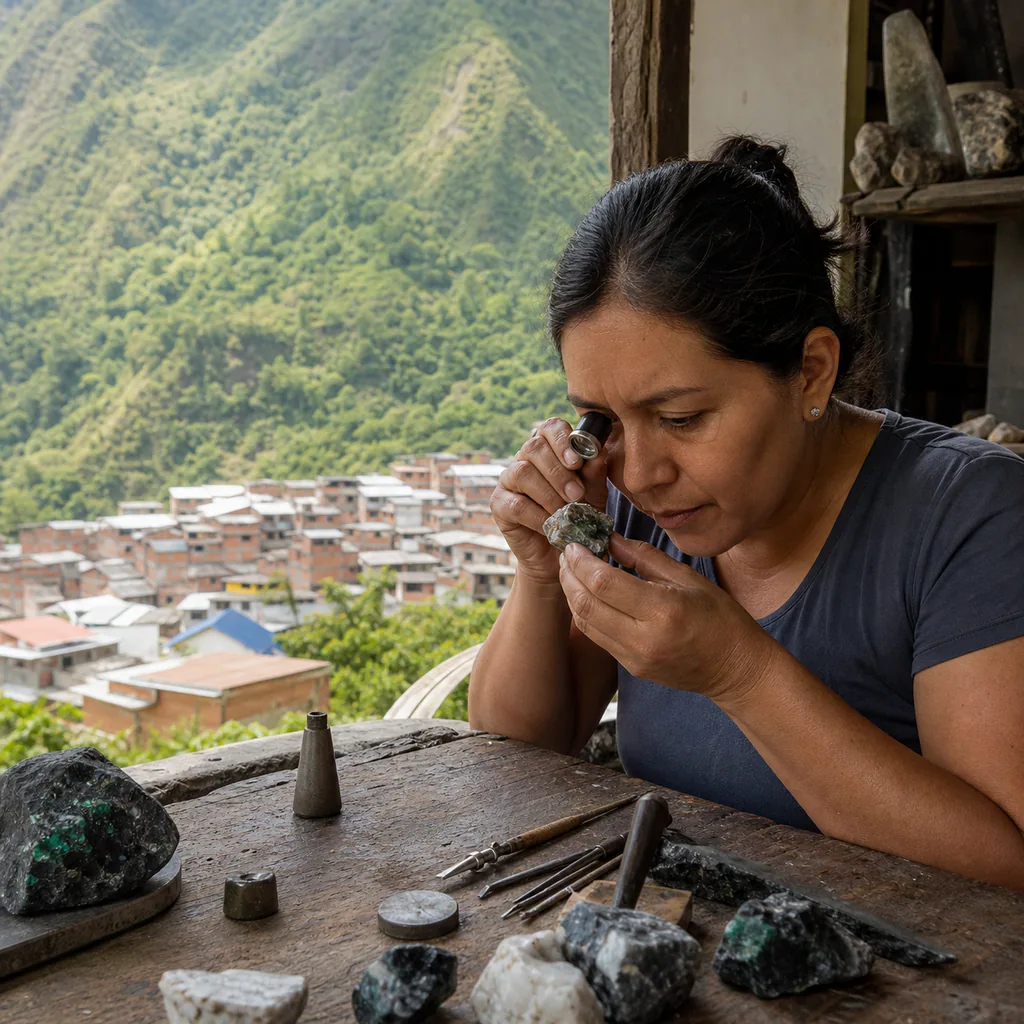
Muzo is often reduced to a single phrase: the emerald capital of the world. The description is memorable, but it hides the more interesting destination. This western Boyacá town occupies a steep, intensely green valley where mineral geology, Indigenous memory, family work, trade, agriculture, and difficult mining history meet.
A thoughtful visit in 2026 is not a hunt for a cheap stone. It is an opportunity to understand the people and skills behind Colombia's best-known gemstone. Allow at least one night in Muzo, arrange any mining experience before arrival, and use our Muzo marker on the interactive map to connect the guide with local planning tools.
Read the Landscape Before the Gemstone
The journey into Boyacá's western emerald region is part of the experience. Folded mountains, river valleys, humid vegetation, farms, exposed rock, and settlements on difficult slopes explain why distance alone is a poor measure of travel time. Build margin into the day, travel in daylight, and confirm the latest road and transport conditions with your accommodation or guide.
The official Boyacá tourism profile for Muzo presents emerald extraction as the principal economic activity, while also noting local crops such as cacao, coffee, cassava, and sugar cane. That wider economy matters. Look beyond mine entrances and gem counters: meals, farms, transport, workshops, and small shops all reveal how the town functions.
Begin in Town, Not Inside a Mine
Start with public spaces and interpretation. The regional tourism profile identifies the main park and Nuestra Señora de La Naval parish among the municipality's attractions. The official Colombia Travel emerald route also describes a local museum collection with rough stones, archaeological pieces, and historic photographs connected with the trade.
Confirm the museum's current location, opening arrangements, and whether a guided visit is available before relying on it. Exhibits and local specialists can teach you to distinguish a crystal in its host rock from a cut stone, understand why color and clarity vary, and see how extraction, sorting, cutting, and jewelry are different stages of one value chain.
Visit Mining Areas Only Through an Authorized Experience
A working emerald site is not an open-air attraction. Machinery, unstable ground, water, vehicle movement, steep waste piles, restricted property, and active excavation create risks that a visitor cannot assess from a roadside viewpoint. Never enter a tunnel, cross a fence, climb a spoil pile, or follow an informal invitation without the operator's explicit authorization.
Before booking, ask for the tourism provider's registration, the exact site and route, landowner or mine authorization, insurance, protective equipment, emergency procedure, physical requirements, and photography rules. Confirm whether the activity is an observation visit, a controlled demonstration, or access to a working area. If the answers remain vague, choose a museum, workshop, or town-based experience instead.
Colombia Travel describes community mining experiences as a way to learn directly from local expertise. The key word is organized. A helmet and boots do not make an improvised visit safe, and paying someone at an entrance does not automatically establish permission or insurance.
Listen to Guaqueras and Local Artisans
Guaquería, the search for emerald fragments in material released from mining, forms part of the region's social history. It should not be presented as a visitor treasure game or a guarantee of finding something valuable. Boyacá's tourism information notes organizations created to dignify, train, and improve opportunities for women guaqueras. Their knowledge belongs within a story of work, persistence, and changing access to the formal economy.
When a community host or artisan explains sorting, polishing, or jewelry, listen before filming. Ask permission for portraits and close-ups of hands, tools, stones, or transactions. Pay the stated price for a workshop or interpretation rather than expecting a demonstration in exchange for exposure on social media.
Buy an Emerald with Better Questions
An attractive green stone is not automatically a valuable natural Colombian emerald. Buy only from an established business willing to issue a detailed receipt. Ask whether the stone is natural or synthetic, loose or mounted, its weight, whether it has been treated, what the seller means by origin, and whether an independent laboratory report accompanies it. A verbal promise is not equivalent to documentation.
Do not pressure a guaquera or miner into a rushed street transaction, carry large amounts of visible cash, or assume that bargaining harder supports the community. In 2025, the National Mining Agency highlighted formal and transparent commercialization as central to strengthening Muzo's emerald value chain. Responsible buying means clarity for both parties, not merely a low price.
Practical Tips
- Stay overnight: Mountain travel can be slow, and a rushed out-and-back trip leaves little room for the town itself.
- Arrange the guide first: Confirm the operator, meeting point, route, insurance, and protective equipment in writing.
- Dress for uneven ground: Wear closed shoes with grip and carry rain protection, water, and sun protection.
- Keep valuables discreet: Photograph stones and transactions only with permission, and avoid displaying cash.
- Request documentation: Obtain an itemized receipt and ask direct questions about treatment, weight, origin, and certification.
- Check conditions locally: Verify road, museum, and tour availability shortly before traveling.
🕵️ Insider Secrets
- Study the host rock: Seeing tiny green crystals beside calcite and dark rock is more educational than staring only at polished jewelry.
- Visit the park slowly: Everyday conversation around the center often gives better context than a tightly scheduled photo stop.
- Ask who added the value: Mining, sorting, cutting, setting, and selling may involve different people and places.
- Choose interpretation over access: A knowledgeable workshop can be more rewarding than a poorly explained mine entrance.
- Make room for local food: Muzo's agricultural life is an important counterweight to the emerald story.
Muzo becomes more compelling when the emerald is treated as a beginning rather than the whole story. Arrive with time, learn from authorized hosts, respect working areas, and buy only when the provenance and terms are clear. The result is a richer encounter with both the green stone and the community that has lived around it for generations.
eSIM for Colombia
Avoid high roaming fees. Get instant 4G/LTE data with Airalo as soon as you land in Bogotá or Medellín.
- Instant Activation
- No Physical SIM Card
- Local & Regional Plans