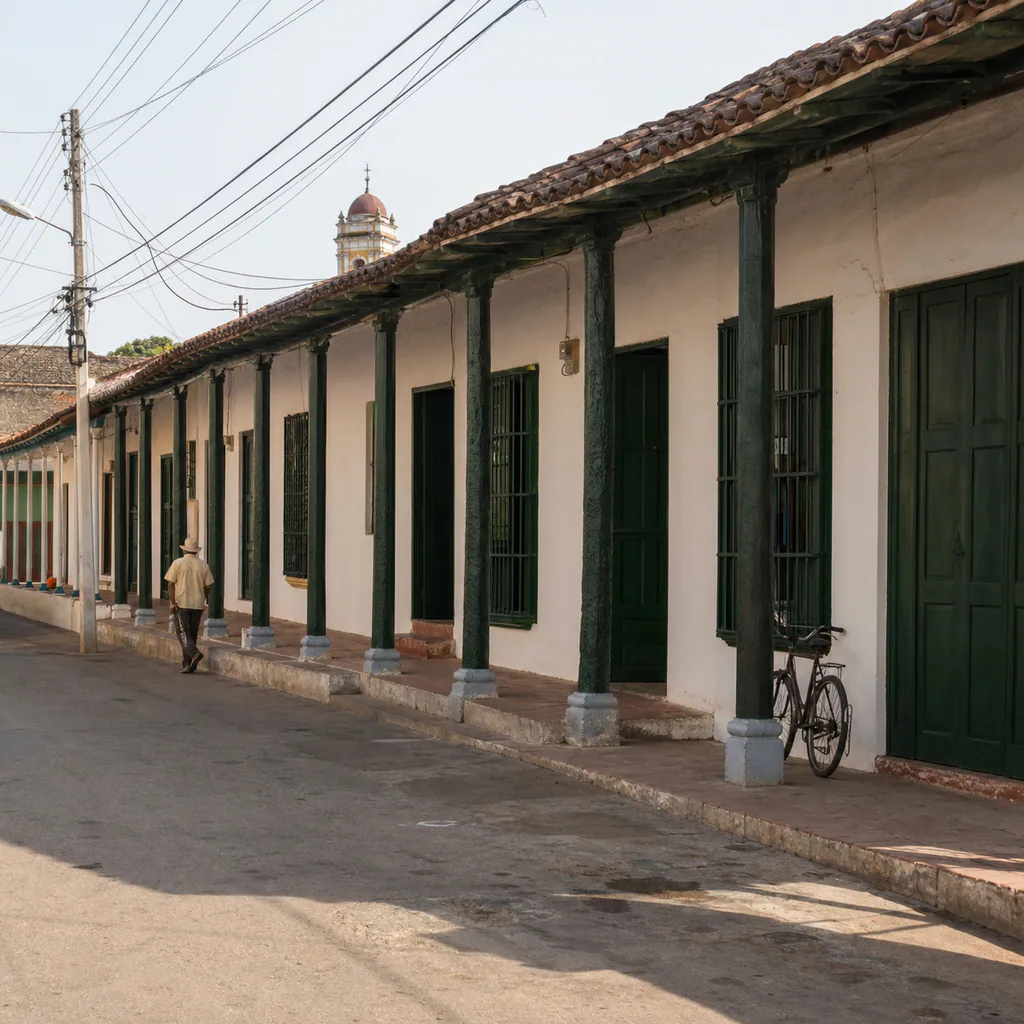
Ambalema does not announce itself with a monumental plaza or a polished museum district. Its character appears gradually under long covered walkways, where rows of timber posts hold clay-tile roofs above whitewashed facades. These shaded corridors give the small Tolima town its nickname, the City of a Thousand and One Columns, while the nearby Magdalena River explains why trade once brought such unusual prosperity to its streets.
A visit in 2026 is about reading a landscape that remains inhabited. Paint may be faded, access to important buildings may be limited, and midday heat changes the pace. Walk slowly and let architecture, tobacco memory, railway traces, and river life form one connected story.
Read the City Beneath the Columns
The official Colombia Travel guide to Ambalema highlights the columned houses that define its historic center. Rather than isolated showpieces, the columns create repeated porticos along ordinary streets. They shade doors, windows, conversations, and the transition between home and road. Their rhythm is best appreciated on foot, especially when angled light reveals the texture of timber, roof tiles, plaster, and deep verandas.
Ambalema's center was declared a National Historic Monument in 1980 and is now protected as a national cultural-interest site. The Ministry of Culture's special management and protection plan treats the center as a living place, not a decorative shell. That distinction matters to visitors: people still work, rest, study, and raise families behind these facades. Photograph from a respectful distance, never enter a corridor or doorway that appears private, and avoid using fragile columns as props.
Follow the Tobacco Story Without Nostalgia
Tobacco shaped Ambalema's urban growth during the eighteenth and nineteenth centuries. The Ministry of Culture's history of the conservation plan explains that leaves from the Tolima valley moved through the river port toward Caribbean ports and Europe. Warehousing, processing, navigation, and later rail transport left physical marks across the town.
Read that prosperity critically. Tobacco history includes agricultural labor, factory work, uneven wealth, commercial migration, and dependence on changing transport systems. Ask local guides how families remember the industry rather than reducing the past to romantic images of cigars and steamships. The most useful stories often concern daily work, the decline of a trade, and the ways buildings found new uses afterward.
Build an Exterior Heritage Walk
The Tolima government's Ambalema inventory identifies the former Factoría La Patria, the Art Deco railway station, La Casona, the historic center, and the riverfront among the town's reference points. Several have restricted interiors, structural concerns, or changing uses. Plan an exterior route first and consider any interior access a confirmed bonus, never an expectation.
Begin among the continuous porticos, noticing how vernacular construction responds to sun and rain. Continue toward the former tobacco complex and the railway area, then finish near the Magdalena riverfront. Do not cross barriers, climb onto disused rail equipment, or enter an apparently open heritage building without permission. A local cultural guide can add context and direct fees into the community while helping you distinguish public routes from vulnerable private property.
Meet the Magdalena at the Town's Pace
The river is not background scenery. It was Ambalema's transport corridor, commercial connection, workplace, and eastern edge. From the public riverfront, watch how boats, fishing activity, water level, and weather shape the day. Conditions can change quickly, so keep back from unstable banks and ask locally before considering any crossing or boat trip. Use an established operator, confirm life jackets, and accept cancellation when crews judge the river unsuitable.
Early morning and late afternoon generally make the riverfront more comfortable than midday, but do not sacrifice safe daylight travel to chase a photograph. Avoid leaving litter, buying wildlife, or interrupting fishers at work. If someone explains a boat, net, or river custom, ask before recording them and offer fair payment when the exchange becomes a guided experience.
Plan a Realistic North Tolima Stop
Ambalema is warm, low-lying, and quieter than nearby heritage hubs. Carry water and sun protection, choose breathable clothing, and expect limited opening information online. Confirm accommodation and transport directly, particularly if arriving late or outside weekends. Cash is useful for small meals and local services, while a flexible schedule protects you from treating a living town like a timed museum.
Honda and Mariquita can complement the tobacco, river, railway, and scientific history of northern Tolima, but each deserves its own day. Build Ambalema as a deliberate stop rather than a rushed detour between them. Roads, weather, and local transport can alter journey times, so travel in daylight and ask your host about the current route before departure.
Practical Tips
- Start early: Walk the porticos before the strongest heat and leave time for unplanned conversations.
- Confirm access: Treat historic interiors as closed unless a responsible host explicitly welcomes you.
- Bring sun protection: Carry water, a hat, sunscreen, and light clothing even though the corridors provide shade.
- Use careful footwear: Uneven paving, railway edges, and weathered surfaces reward shoes with grip.
- Ask before photographing: Homes, school spaces, workers, and private verandas are not automatic photo sets.
- Check onward transport: Confirm the last practical departure rather than relying on an old online timetable.
🕵️ Insider Secrets
- Follow the shade: The continuous covered walk reveals how architecture responds to Ambalema's climate.
- Look above eye level: Roof joints, beams, and column spacing often tell more than freshly painted walls.
- Compare eras: The vernacular porticos and Art Deco railway station make a useful visual contrast.
- Listen for working history: Ask about tobacco labor, trains, boats, and later building uses, not only famous owners.
- End by the river: The port makes the town's location and commercial past easier to understand after the walk.
Ambalema is most memorable when its apparent stillness becomes legible. Columns manage heat, old warehouses recall labor, railway traces mark a changing economy, and the Magdalena continues moving beside them all. Give the town a full, unhurried day and its heritage becomes more than a backdrop: it becomes a conversation between architecture, work, water, and the people living there now.
eSIM for Colombia
Avoid high roaming fees. Get instant 4G/LTE data with Airalo as soon as you land in Bogotá or Medellín.
- Instant Activation
- No Physical SIM Card
- Local & Regional Plans