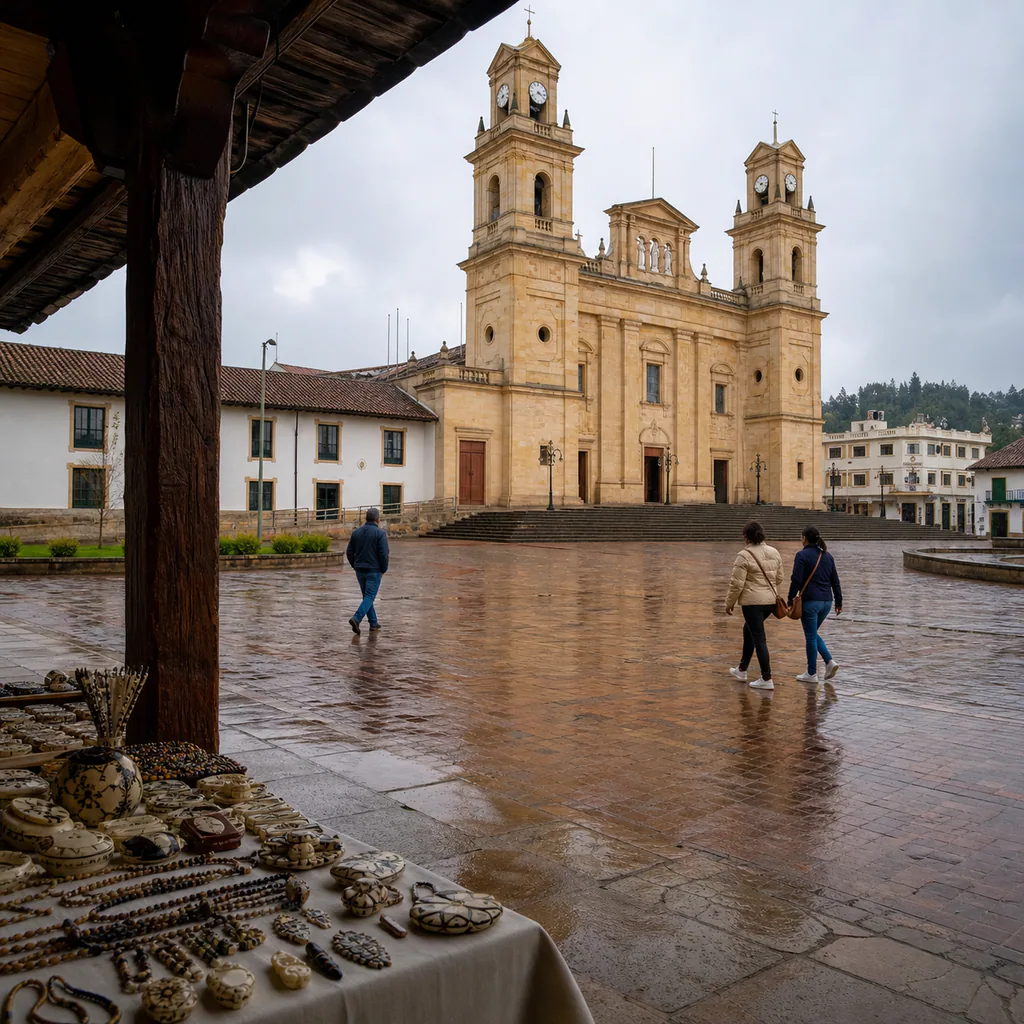
Chiquinquirá is often introduced as Colombia's religious capital, but that is only a doorway. Pilgrims arrive for the revered image of Our Lady of the Rosary; around them, a working Boyacá town carries on through markets, schools, dairy shops, crafts, railway memory, and two public squares with distinct personalities.
An overnight visit lets these layers settle into place. Begin with the verified Chiquinquirá city page, locate the historic center through the Chiquinquirá marker on the interactive map, and treat worship schedules as part of daily life rather than an obstacle to sightseeing.
Begin at Plaza de la Libertad
The pale sandstone Basilica of Our Lady of the Rosary gives Plaza de la Libertad its scale. Boyacá's official tourism record for the basilica dates its construction from 1796 to 1823 and identifies the original devotional painting at the main altar. Look up at the balanced twin towers, central pediment, broad steps, and the relationship between the monumental façade and the low buildings around the square.
Inside, slow down. A service, rosary, funeral, or private prayer takes priority over a visitor's photo. Silence your phone, remove hats where requested, keep clear of worshippers, and ask before photographing the painting or interior. Secular travelers can approach the building as architecture and living heritage, provided observation never becomes intrusion.
The annual feast on 9 July draws especially large pilgrim numbers, according to the Government of Boyacá. If that celebration is your purpose, reserve transport and lodging early. If you prefer a quieter architectural visit, choose another date and arrive near opening time after confirming the day's services.
Follow the Story Beyond One Sanctuary
Chiquinquirá's devotional geography continues at the Templo de la Renovación, associated with the local tradition of the painting's renewal. Approach the story as both faith and cultural memory: listen to how residents tell it, distinguish devotional belief from documented chronology, and avoid reducing a sacred object to a curiosity.
The Museo Mariano adds context through religious art and material culture. Hours can change around ceremonies and holidays, so verify access locally. A guide or museum mediator can explain why Chiquinquirá became a national pilgrimage center and how visitors shaped commerce, music, hospitality, and the urban center.
National heritage records also list Chiquinquirá's former railway station as a protected cultural property. Today the railway story offers a useful counterpoint to the basilica: faith brought people here, but transport infrastructure changed how they arrived and how western Boyacá connected with larger markets.
Walk Between Plaza, Park, and Cultural Rooms
Do not leave immediately after the basilica. The municipality's official tourism profile links Plaza de la Libertad with Parque Julio Flórez, the Casa de la Cultura José Joaquín Casas, the Museo Mariano, and the former station, now used as the Palacio de la Cultura Rómulo Rozo. Together they form a compact cultural circuit rather than a checklist of isolated monuments.
Move through it at street pace. Notice painted wooden balconies, commercial façades, old houses adapted to new uses, and the exchange between pilgrimage and town business. Ask permission before photographing vendors or worshippers, and buy directly when an artisan explains a piece.
Chiquinquirá is also associated with wood carving, musical instruments, tagua work, religious objects, and brightly formed sugar sweets. Quality varies, so ask where an item was made and what material was used. A locally produced object with a clear maker has more meaning than an anonymous souvenir presented as tradition.
Taste the Highland Town and Stay the Night
Western Boyacá's agricultural economy appears in simple lunches, bakeries, cheese counters, milk-based sweets, potatoes, corn, soups, and seasonal produce. Follow what residents are ordering instead of searching for one supposedly definitive dish. Markets and family restaurants are better places to understand the town's regional role than a hurried roadside stop.
Chiquinquirá connects naturally with routes toward Ráquira, Tinjacá, Villa de Leyva, Ubaté, and the emerald country around Muzo, but combining all of them in one day weakens each visit. Spend the night, give the historic center a morning and an afternoon, then choose one onward direction with confirmed transport and daylight.
Practical Tips
- Verify worship and museum hours: Ceremonies, feast days, maintenance, and cultural events can alter public access.
- Dress for respect and altitude: Carry a warm layer and rain protection, and use modest clothing inside active churches.
- Plan ground transport carefully: Confirm the current terminal, departure time, luggage policy, road conditions, and final return service.
- Keep some cash: Small eateries, market stalls, local transport, and independent artisans may not accept cards.
- Ask before taking portraits: Pilgrims, clergy, vendors, and craftspeople are people, not background decoration.
- Protect heritage surfaces: Do not climb monuments, touch artwork, block doorways, or fly a drone without permission.
🕵️ Insider Secrets
- Arrive after light rain: Damp plaza paving reflects the sandstone façade and softens the usual midday contrast.
- Compare the two civic spaces: Plaza de la Libertad feels ceremonial, while Parque Julio Flórez reveals a more everyday rhythm.
- Ask who made it: That question quickly separates local tagua, wood, or instrument craft from generic merchandise.
- Listen before reading every label: A local mediator's explanation connects the sacred image with migration, transport, and commerce.
- Stay for an ordinary morning: The town becomes most legible when shops open and residents reclaim the center after day visitors leave.
Chiquinquirá rewards travelers who see devotion as a living relationship rather than a spectacle. Give the basilica the quiet it deserves, then keep walking: the plazas, cultural rooms, workshops, food counters, and railway traces reveal a Boyacá town whose identity is broader and more human than any single monument.
eSIM for Colombia
Avoid high roaming fees. Get instant 4G/LTE data with Airalo as soon as you land in Bogotá or Medellín.
- Instant Activation
- No Physical SIM Card
- Local & Regional Plans