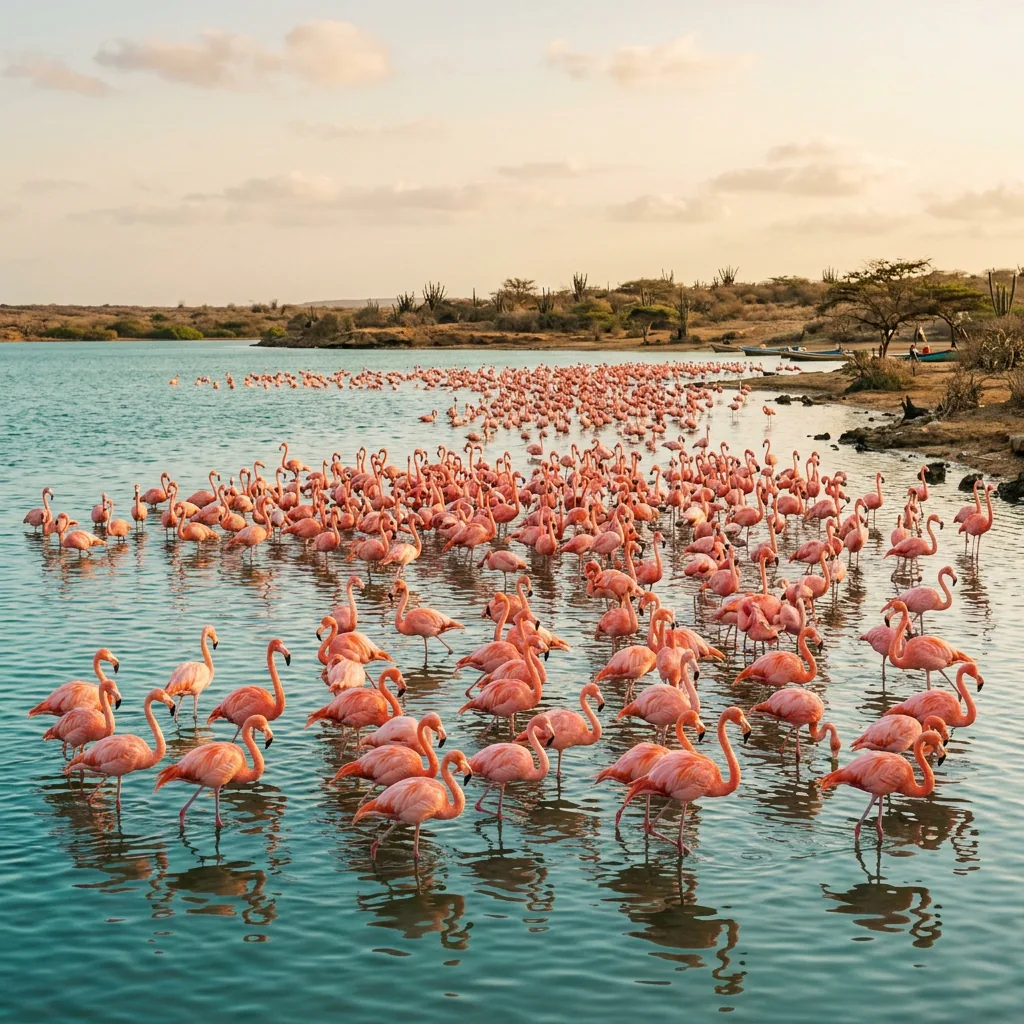
Los Flamencos Flora and Fauna Sanctuary is open for visits in 2026, but it is not an unregulated roadside flamingo stop. Entry without a local guide or heritage interpreter is prohibited. Visitors must register and attend an induction, and the official schedule runs daily from 7:00 a.m. to 4:00 p.m., with everyone outside the protected area by 5:00 p.m.
Start with the canonical Los Flamencos park page and recheck the official sanctuary page close to departure. The park currently charges no admission fee, but guiding, transport, light-boat outings, meals, accommodation, insurance, and other services are separate. A free entrance does not mean a free or self-guided visit.
How to Reach Los Flamencos from Riohacha
Riohacha is the practical base. Camarones lies about 20 km west of the city on the Caribbean highway toward Santa Marta. From the settlement, the local approach continues roughly 3.5 km toward Boca de Camarones and the sanctuary visitor area. Confirm whether your arrangement starts in Riohacha, at the highway junction, in Camarones, or at the coast; those are different pickup points.
A prearranged transfer is simplest when time is limited. Before accepting a quote, ask whether it includes both directions, waiting time, the local guide or interpreter, any boat segment, insurance, and the return to your Riohacha accommodation. If travelling independently to Camarones, agree on the final connection and return plan before leaving the highway. Do not assume that a passing vehicle will be available when the sanctuary closes.
Flamingos Depend on the Lagoons, Not a Calendar Promise
The protected area contains four coastal lagoons: Chentico, Navío Quebrado, Laguna Grande, and Manzanillo. Their water, salinity, food supply, and connection with the Caribbean change with rainfall and local conditions. American flamingos move in response, so flock size and viewing distance can vary substantially. No responsible guide can guarantee a large pink congregation on a particular date.
Ask what has been observed recently and which activity is operating without disturbing the birds. Depending on conditions and current authorization, a visit may combine observation from shore, a light-boat outing, dry-forest walking, non-commercial photography, beach time, and interpretation of local ecosystems and culture. Let the guide choose the safe distance and route. Approaching a flock for a closer photograph can interrupt feeding and waste the energy the birds need.
Birdwatching Beyond the American Flamingo
Los Flamencos is recognized as an important area for resident and migratory birds. The flamingo is the emblem, but the official species record also includes roseate spoonbills, great blue herons, snowy egrets, white ibis, kingfishers, shorebirds, gulls, and the mangrove black hawk. A quieter day with fewer flamingos can still be an excellent wetland visit when the guide helps identify feeding behaviour, flight patterns, and the relationship between birds and changing lagoon edges.
The sanctuary protects more than waterbirds. Its roughly 7,000 hectares include mangroves, tropical dry and very dry forest, desert scrub, and beach habitat. Reptiles, mammals, fish, and crustaceans depend on this connected landscape. Treat the visit as an ecosystem experience instead of measuring its value by one photograph.
Local Guidance and Wayuu Territory
Camarones and the surrounding sanctuary are living community territory, not an empty wildlife backdrop. Local Wayuu knowledge is central to visitor interpretation and conservation. A guide can explain lagoon names, weather, fishing practices, plants, bird movement, and the rules that protect both the ecosystem and community life.
Ask before photographing people, homes, ceremonies, crafts, or children. Do not treat cultural interaction as an automatically included performance. Agree on services and prices clearly, carry cash in small denominations, and buy food, interpretation, or crafts directly when appropriate. Respectful spending supports the people doing the daily work of welcoming visitors and protecting the sanctuary.
Practical Tips for a Responsible Visit
- Confirm access the day before: Check the official status, opening hours, lagoon conditions, meeting point, and planned activity with the sanctuary or guide.
- Use the required local guide: Verify who will guide or interpret the visit and whether registration and induction are included in the schedule.
- Clarify every cost: Park admission is currently free, while transport, guiding, boats, meals, accommodation, insurance, and other services may be charged separately.
- Prepare for heat and sun: Carry sufficient water, a hat, breathable clothing, closed footwear, and biodegradable sun protection.
- Leave single-use plastics behind: The official guidance prohibits them inside the protected area. Take every item of waste back out.
- Protect equipment: Salt spray, sand, and sudden showers are hard on cameras and phones. Use a dry bag and avoid changing lenses in exposed conditions.
- Keep expectations flexible: Bird numbers, boat access, and the best observation sector can change with water, wind, and wildlife movement.
🕵️ Insider Secrets: Questions to Ask Before Paying
- Where exactly does the trip begin and end: Riohacha, Camarones, or Boca de Camarones?
- Is the named local guide or heritage interpreter included for the entire protected-area visit?
- What have guides observed in the lagoons recently, without promising a guaranteed flamingo count?
- Is a light-boat outing planned, and what happens if wind, water depth, or sanctuary instructions prevent it?
- Are accident insurance, transport, meals, community services, and waiting time included or paid separately?
- What is the cancellation or alternative plan if access or weather conditions change?
Keep the Los Flamencos map entry, official status, park page, and this guide together when planning. The sanctuary works well as a focused day from Riohacha, but it should not be squeezed between long Alta Guajira transfers. Give the wetlands enough time for patient observation, follow the local guide, and let the real lagoon conditions shape the experience.
eSIM for Colombia
Avoid high roaming fees. Get instant 4G/LTE data with Airalo as soon as you land in Bogotá or Medellín.
- Instant Activation
- No Physical SIM Card
- Local & Regional Plans