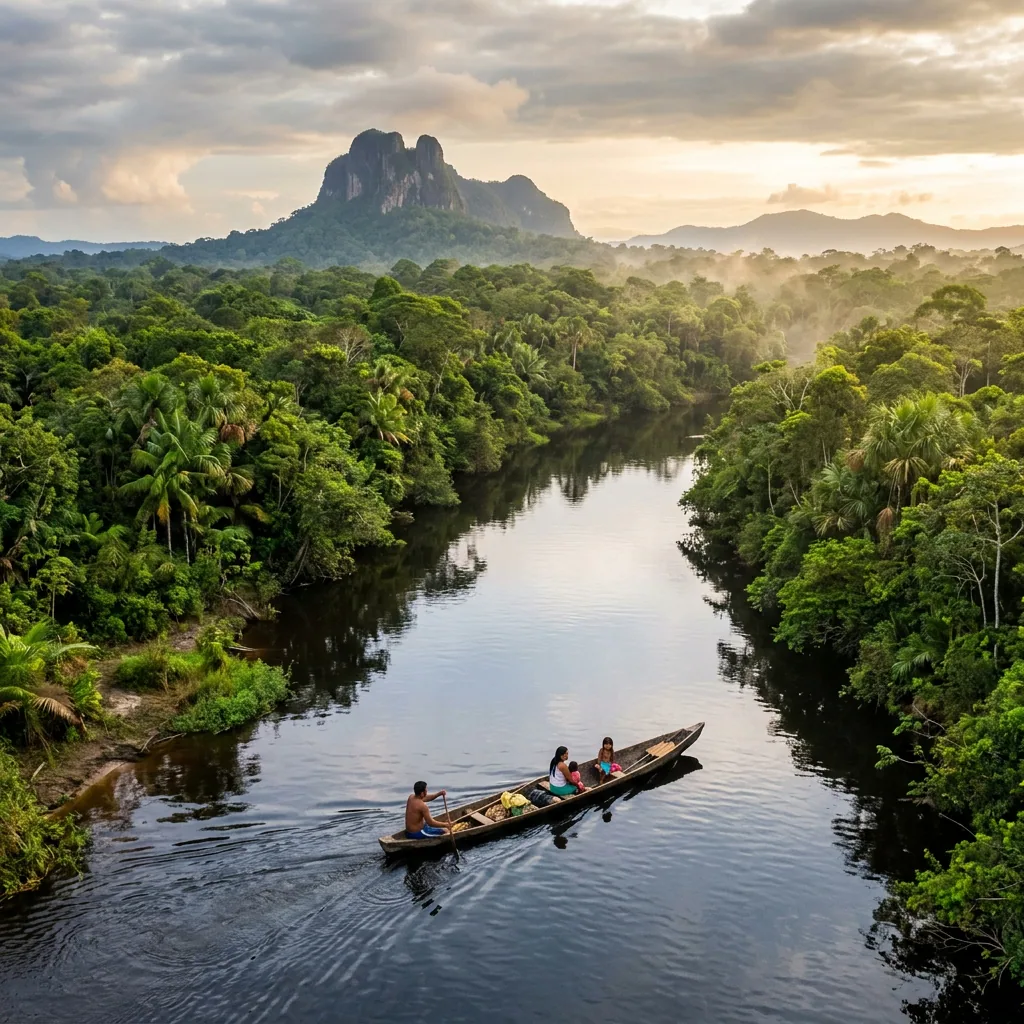
For the traveler who has seen the colonial charm of Cartagena and the urban energy of Medellín, Mitú represents the final frontier. As the capital of the Vaupés department, Mitú is a city disconnected from the national road network, accessible only by air or a long river journey. In 2026, it remains one of Colombia's most culturally intact and ecologically diverse destinations—a place where the Amazon rainforest meets the ancient rocks of the Guyanese Shield. This is a land of red rivers, dancing birds, and over 25 indigenous ethnic groups, offering a level of immersion that is rare in the modern world.
This guide explores the rugged beauty and ancestral secrets of Mitú as it stands in 2026.
The Red River: Life on the Vaupés
The Vaupés River is the lifeblood of Mitú. Unlike the brown, silt-heavy waters of the main Amazon, the Vaupés is a "blackwater" river, stained dark red by the tannins of decaying leaves. In 2026, the river remains the primary highway for the region. A boat journey from the city's main port takes you past indigenous communities where daily life still revolves around fishing, mandioca (cassava) cultivation, and the rhythmic sound of the paddle.
The river is also home to spectacular rapids, or "Cachiveras." In 2026, guided trips to Cachivera de Urania or the more distant Jirijirimo offer a chance to witness the raw power of the water as it crashes over ancient stone steps. These sites are not just natural wonders; they are sacred spaces for the local indigenous groups, often linked to creation myths and ancestral spirits.
Monoliths in the Jungle: Cerro de Urania
Rising abruptly from the emerald carpet of the jungle is the Cerro de Urania. This massive granite monolith is a remnant of the Guyanese Shield, one of the oldest geological formations on Earth. In 2026, the hike to the summit is a highlight for adventurous travelers. The trail leads through dense primary forest, where you might spot giant blue morpho butterflies and hear the distant roar of howler monkeys.
From the top, the view is staggering. You look out over an endless ocean of trees, broken only by the shimmering silver ribbon of the Vaupés River. In 2026, local guides from the nearby indigenous communities provide invaluable context, explaining the spiritual significance of the mountain and identifying the medicinal plants that grow along the path.
The Dance of the Cocks-of-the-Rock
For birdwatchers, Mitú is a bucket-list destination. In 2026, it is recognized as one of the best places in the world to see the Guianan Cock-of-the-Rock. Just a short journey from the city center, there are several "leks"—communal mating grounds—where these brilliant orange birds perform elaborate dances to attract mates.
In 2026, community-led birding tours have become a model for sustainable tourism in the region. Besides the Cock-of-the-Rock, the area around Mitú is home to rare species like the Fiery Topaz hummingbird and the Pompadour Cotinga. The diversity of life here is a constant reminder of the Amazon's importance to the planet's health.
Practical Tips for the 2026 Amazon Traveler
- Logistics: Flights to Mitú from Bogotá are infrequent and can be affected by weather. In 2026, always allow for a "buffer day" in your itinerary. Use regional airlines like Satena for the most reliable service.
- Health: Vaupés is a yellow-fever risk area and proof of vaccination may be requested for travel; protection normally needs at least ten days to develop. Discuss vaccine contraindications and whether malaria prevention medication is appropriate for your exact route with a qualified travel-health professional, and use effective mosquito-bite precautions.
- Cultural Protocol: You are entering indigenous territories. In 2026, it is essential to travel with a local guide and to ask for permission before taking photographs of people or entering communal longhouses (Malokas).
- Packing: Bring quick-dry clothing, a headlamp, and waterproof bags for your electronics. The humidity in Mitú is intense, and sudden downpours are common year-round.
Mitú is not a destination for everyone. It is a place that demands patience, respect, and a willingness to step outside your comfort zone. But for those who make the journey in 2026, the reward is a connection to a part of the world that feels truly primal. It is a place where the modern world fades away, replaced by the ancient wisdom of the forest and the steady pulse of the red river.
🕵️ Insider Secrets
- The Best Market Day: Visit the local market on Saturday morning. This is when indigenous farmers from the surrounding communities come to town to sell unique jungle fruits like Uva Caimarona and Pupuña, as well as handcrafted baskets and ceramics.
- Secret Swimming: Ask your guide to take you to "La Piscina Natural" near the community of Ceima Cachivera. It’s a calm, crystal-clear pool formed by the river’s edge, surrounded by white sand and jungle flowers.
- Taste of the Forest: Try Quiñapira, a traditional spicy fish soup made with Amazonian peppers. In 2026, some small family restaurants in Mitú serve it in the authentic style, cooked over a wood fire.
eSIM for Colombia
Avoid high roaming fees. Get instant 4G/LTE data with Airalo as soon as you land in Bogotá or Medellín.
- Instant Activation
- No Physical SIM Card
- Local & Regional Plans