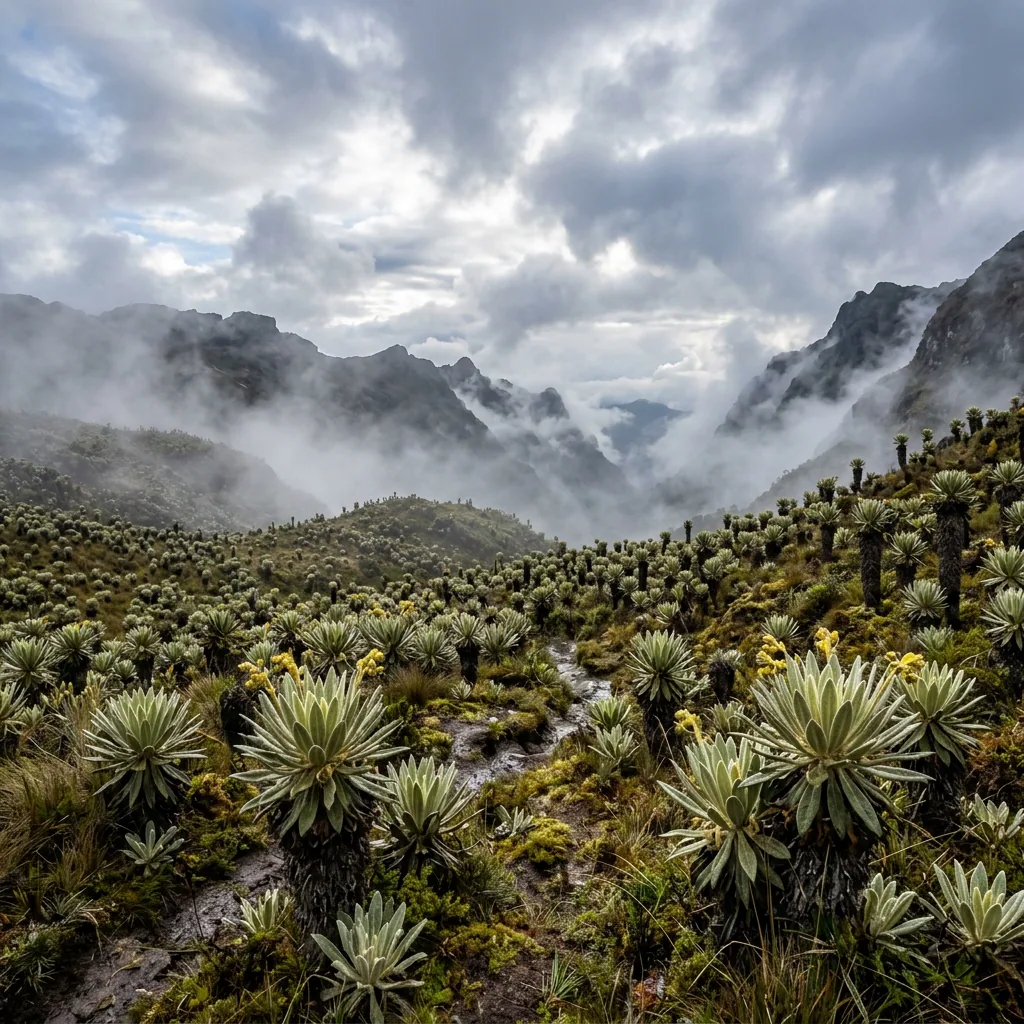
South of Bogotá lies an ecosystem so important to Colombia's water security that its value cannot be measured as a conventional attraction. Sumapaz contains vast páramo, subpáramo, and high-Andean forest landscapes where mist, peat-rich soils, lagoons, and slow-growing frailejones regulate water over enormous distances. It is also a lived and sacred territory, shaped by rural communities, Indigenous history, conflict, restoration, and scientific research.
Parque Nacional Natural Sumapaz is not open to ecotourism, recreation, hiking, birdwatching, or landscape-viewing visits. Its official profile lists the park as closed, and Parques Nacionales Naturales de Colombia restated the restriction on 13 March 2026. This guide is therefore an interpretive conservation guide, not an invitation to enter the park.
Why Sumapaz Matters
Páramo ecosystems occur above the Andean forest and below the permanent snow line. Their saturated soils and specialized vegetation capture moisture from rain, fog, and clouds, then release it gradually into streams and rivers. Sumapaz contributes to watersheds that support Bogotá and communities across Cundinamarca, Meta, and Huila. Protecting its soil and vegetation is inseparable from protecting water quality and resilience during dry periods.
The best-known plants are frailejones, whose dense leaves trap moisture and insulate the plant from cold. They grow slowly and can be damaged in seconds by trampling, fire, off-road vehicles, or an improvised trail. Mosses, grasses, shrubs, and peat soils form the rest of a system that may take decades or centuries to recover after disturbance.
A Protected Territory, Not a Hiking Destination
The absence of an entrance gate or a barrier beside a road does not mean access is permitted. The national park authority states that the public road through the protected area is a vehicle corridor, not an authorized pedestrian route or nature-viewing area. Traffic, parking in unsuitable places, the lack of shoulders or pavements, weather, altitude, and the sensitivity of the habitat all make stopping or walking unsafe.
The March 2026 notice is broader than older online advice: the park has no tourism zoning, authorized routes, interpretive trails, visitor signage, control points, support infrastructure, visitor protocols, or tourism contingency plan. The presence of people near Laguna de Chisacá does not mean that walking, stopping, parking, birdwatching, photography, or approaching the water has been authorized.
Ignore social-media routes, map pins, and operators that advertise unofficial hikes inside the park. A paid guide cannot turn a prohibited activity into an authorized one. Entering restricted areas can damage water-regulating soils, disturb wildlife, create rescue risks, and disrespect local governance.
Ecology and Cultural Meaning
Sumapaz supports high-altitude birds, amphibians, deer, and the Andean bear, although wildlife should not be pursued or approached. Its lagoons and mountains also hold deep significance in Muisca traditions and in the histories of the campesino communities that have cared for and worked across the wider region. Reducing the territory to an empty wilderness overlooks the people whose knowledge and decisions are central to conservation.
The park's conservation role includes habitat protection, research, ecological restoration, and environmental management. Learning about those functions can be more meaningful than collecting a summit photograph. Museums, botanical gardens, university programs, official talks, and community initiatives outside restricted zones can introduce visitors to páramo ecology without placing pressure on Sumapaz itself.
Responsible Ways to Learn
- Start with the official notice: Read the 13 March 2026 Sumapaz access guidance from Parques Nacionales before making any plan.
- Choose authorized alternatives: Visit established environmental education spaces and lawful community projects outside the national park boundary.
- Do not stop on the park road: The authority explicitly warns against using it for pedestrian access, viewing, parking, or photography.
- Protect location data: Avoid sharing unofficial tracks or precise wildlife and lagoon coordinates that can encourage unauthorized entry.
- Respect local decisions: Conservation rules and community protocols take precedence over an itinerary or a tour advertisement.
Practical Tips
- Verify boundaries: A place marketed as “Sumapaz” may be in the wider region rather than inside the national park; ask for the exact location and authorization.
- Check the date: Old trip reports may describe access that is no longer legal or safe.
- Prepare for altitude: Even lawful nearby experiences can involve cold, UV exposure, rapid weather shifts, and elevations above 3,000 meters.
- Leave no trace: On authorized routes outside the park, remain on durable surfaces and carry out every item.
🕵️ Insider Secrets
- Read the water story: Trace the Tunjuelo and other Bogotá water systems on a map before your visit; it reveals how the páramo connects to daily urban life.
- Look beyond a viewpoint: A guided talk about frailejón growth, peat soils, and rural stewardship often provides more insight than a quick roadside photograph.
- Use official updates: Save the park authority's page rather than relying on cached directions or old hiking apps.
Sumapaz deserves attention precisely because it is not a recreational product. Use the canonical Sumapaz park profile and the map access notice to recheck the restriction without turning the marker into directions. The responsible approach in 2026 is to understand the páramo's ecological work, follow current rules, and support learning that does not require entering a protected landscape closed to tourism.
eSIM for Colombia
Avoid high roaming fees. Get instant 4G/LTE data with Airalo as soon as you land in Bogotá or Medellín.
- Instant Activation
- No Physical SIM Card
- Local & Regional Plans